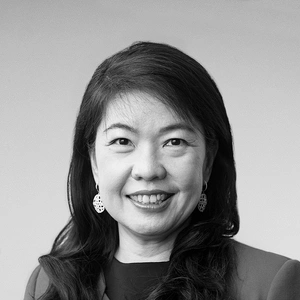
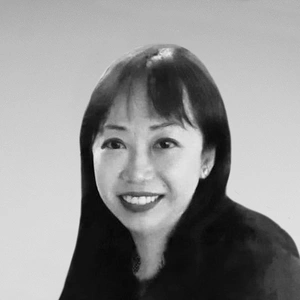

Monicca Yan, Managing Director, and Veronica Lee, Regional Business Development Director Asia at Kestria China & Singapore, interviewed Susan Chong, Founder and CEO of Greenphyto, about the future of food security, the role of controlled-environment agriculture and the innovations driving scalable vertical farming. A pioneer in sustainable business and agritech, Susan founded Greenphyto to address one of the world's most pressing challenges: ensuring reliable food production in the face of climate change, land scarcity, and shifting agricultural demographics. Under her leadership, Greenphyto has developed patented technologies that combine automation, AI-driven monitoring and controlled-environment agriculture to produce high-quality vegetables efficiently and sustainably at scale.
From sustainable packaging to agritech entrepreneurship
Before Greenphyto, you invested in sustainable packaging—what motivated that focus, and how has that experience shaped your approach to building a company in controlled environment agriculture today?
I began my sustainability journey 25 years ago in sustainable packaging, driven by the belief that greater impact comes from preventing waste through better design and material selection rather than simply managing it.
As discussions around climate change, packaging waste and food waste intensified, I began exploring what I saw as the next major sustainability challenge: food security. Despite having no farming background and operating in Singapore, I started experimenting with food production through an office garden before transitioning to hydroponics.
What began as a personal interest evolved into a community initiative focused on helping people grow their own food. Over time, we shared knowledge, donated hydroponic systems and collaborated with schools. These efforts were recognised with Singapore's President's Award for Volunteerism and Philanthropy in 2016/2017.
Through this journey, I recognised an opportunity to apply my supply chain expertise to food security and founded Greenphyto 12 years ago. After winning an SFA and AVA food production competition, the seed funding enabled us to develop our first prototype. Following eight years of R&D, we successfully commercialised the technology.
Five years ago, I sold my packaging business to focus entirely on food security. I believe it will be one of the defining challenges of the future, driven by climate-related disruptions to agriculture and an ageing farming population. In my view, addressing this challenge requires scalable production systems. That is why Greenphyto focuses on automation and controlled-environment agriculture, enabling consistent food production while reducing reliance on scarce agricultural expertise.
The future of vertical farming
How do you see controlled environment agriculture and vertical farming reshaping global food systems over the next decade?
Research and development can be conducted on a small scale, but the ability to scale is what transforms innovation into a viable business. From the outset, we designed our system with large-scale deployment in mind. Our modular approach allows us to expand by adding capacity rather than redesigning operations, making scaling more efficient and sustainable.
Many vertical farming companies struggle to move beyond the R&D stage. In my experience, a business that cannot scale is unlikely to remain sustainable in the long term. Success is not simply about growing vegetables; it is about producing them at a commercially viable cost. Ultimately, the key question is the cost per head of lettuce.
That is why we focus on achieving economies of scale and reducing production costs. Unlike models that rely on future data monetisation or continuous investment, we believe the fundamentals must come first. At the end of the day, we are producing food, and long-term success depends on delivering high-quality vegetables at a price consumers can afford.
Food security and sustainability
To what extent can vertical farming realistically contribute to food security and sustainability, particularly in regions with limited arable land or increasingly erratic climate conditions?
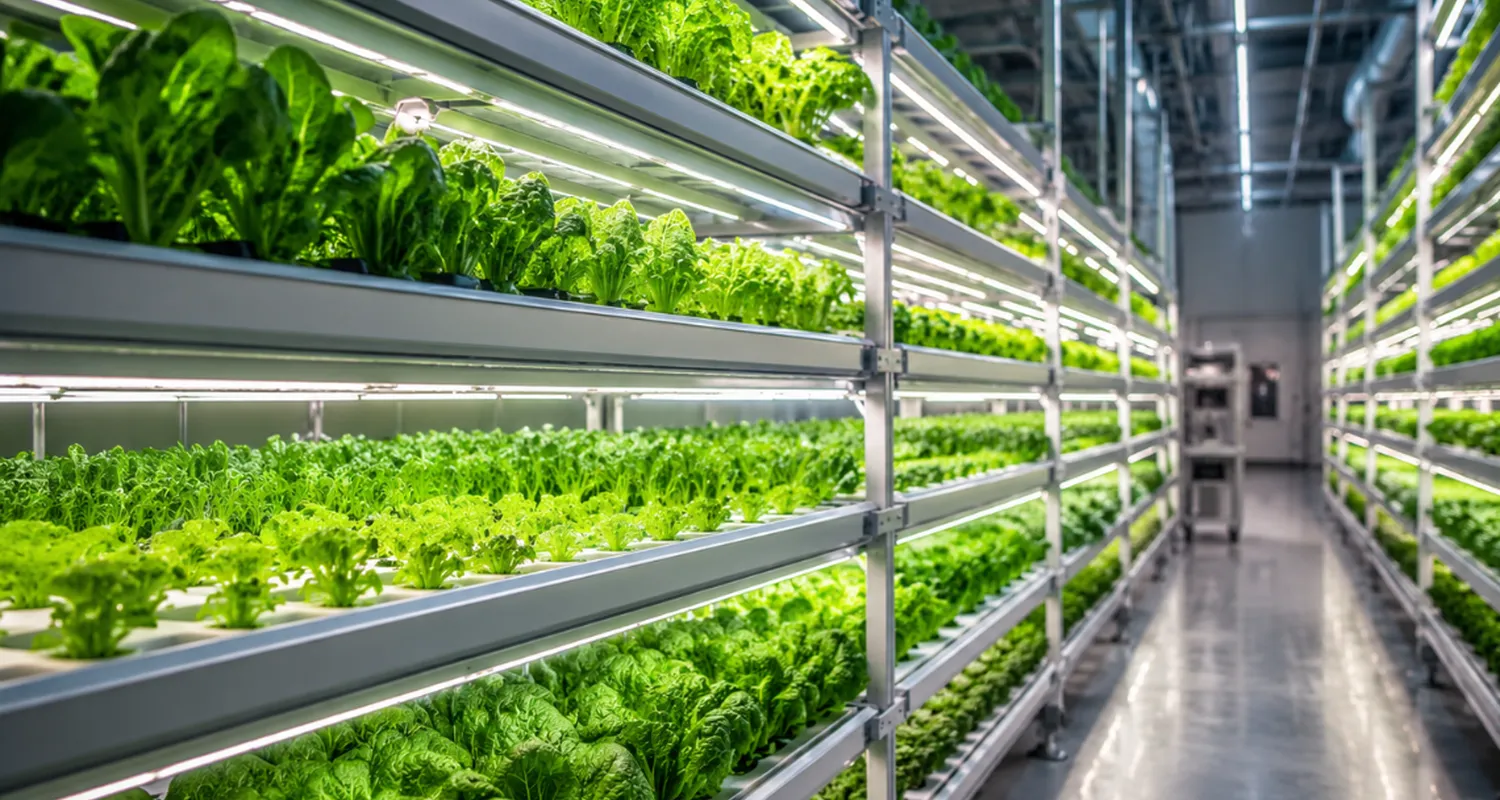
Vertical farming has significant potential due to its scalability, particularly in countries such as Singapore where land is limited. Our crops are approximately 45 times more productive than those grown through traditional farming methods. The purpose of vertical stacking is not to create the tallest possible farm, but to maximise productivity on increasingly expensive land. By utilising vertical space efficiently, it is possible to achieve substantially higher yields within a smaller footprint.
Another important factor is our ability to transform farming into an advanced manufacturing system through the integration of Industry 5.0 technologies and AI-driven monitoring. This enables comprehensive oversight of the growing process and distinguishes us from many other players in the sector. While harvesting still requires some manual intervention, there is considerable potential for further automation, and we are actively working to advance these capabilities.
Crop science and scaling vertical farming
Greenphyto is developing large-scale vertical farming systems—how are your crop science innovations and cultivation methodologies enabling this scale, and to what extent can your model be replicated in other regions?
The breakthrough lies in how we grow vegetables through technology. We have a precise understanding of nutrient levels, temperature requirements, lighting formulas, and all other key growing parameters. As a result, the system can be replicated in virtually any part of the world, provided that environmental conditions can be controlled. We have developed detailed cultivation protocols and recipes that define every parameter required for optimal growth. In essence, scaling the model involves applying these established recipes and protocols, making it highly replicable across different regions.
Innovation and intellectual property
How do you approach intellectual property management within your business, and how can it be leveraged to support and accelerate future innovation in agritech?
Intellectual property is very important because we are operating at the forefront of innovation. Today, we hold 73 patents across 34 countries. Building and maintaining a patent portfolio is a continuous effort and also a very expensive exercise. Therefore, we are very clear that we only patent technologies that are critical and crucial to our business. The objective is not simply to own patents, but to ensure they generate economic returns and improve efficiency.
Owning IP also supports future innovation because it provides the foundation on which we can continue to build and stay ahead technologically. However, at the end of the day, the value of a patent is not the piece of paper itself. What matters is how it can be translated into actual production and the commercial production of vegetables. That is what needs to be protected. Ultimately, everything comes down to commercial viability. Whatever we develop must be commercially sustainable; otherwise, it is not sustainable in the long term. We are not running a charity, but a business that must create real economic value.
How do you motivate your R&D team to drive innovation and contribute to intellectual property development?
There is a strong motivational aspect to intellectual property development. As an SME, we provide opportunities that many young professionals may not otherwise have, including the chance to be named as inventors on patents. We continuously challenge our team to develop novel solutions, and when a breakthrough demonstrates commercial potential, we pursue patent protection.
Several of our young colleagues have already been named as inventors on patented innovations, which is a significant achievement. Such recognition is often associated with senior researchers, PhD holders, or professionals in highly technical industries. We believe this helps differentiate us and encourages a culture of innovation.
Recognition is important to today's workforce. Beyond contributing to food security, our employees have the opportunity to leave a lasting impact on the industry and take pride in innovations they can truly call their own.
What makes talented professionals attracted to Greenphyto, and how do you foster a culture of innovation?
There is a strong sense of pride among our team members. To build a successful company, it is essential to provide a safe sandbox where people can experiment and innovate. I always encourage the team to fail fast. If something is not working, it is important to recognise it early, learn from it, and move forward. We should not be constrained by the fear of failure.
Innovation takes time. In my own experience, it takes about 10 years. Along the way, there are setbacks, lessons, and continuous improvements. Innovation is incremental; it does not happen overnight. Over time, you become better, more efficient, and more effective.
That is why creating a safe sandbox is so important. It gives people the confidence to experiment, learn, and continuously improve.
Leadership in sustainable agriculture
As a pioneer in agritech and sustainable farming, what are the greatest leadership and operational challenges you foresee for Greenphyto in the years ahead?
One of the realities of working with living crops is that there are always uncertainties. Vegetables may be performing well, and then suddenly something changes without an immediately obvious cause. Like any operation, even with established SOPs and processes, unexpected challenges can arise.
The key is to remain focused. That is why I emphasise commercial viability. For us, commercial viability means consistently producing high-quality vegetables at an affordable price. Our innovation efforts are therefore focused on continuously improving product quality while reducing costs. Maintaining that balance is essential to sustaining the business over the long term.
About Greenphyto
Greenphyto is a Singapore-based agritech company pioneering automated, weather-independent farming solutions to strengthen food security in land-scarce environments. Founded by Susan Chong, the company combines controlled-environment agriculture, AI-driven monitoring and proprietary cultivation technologies to produce fresh vegetables at scale. With a strong focus on commercial viability and innovation, Greenphyto operates the world's tallest indoor vertical farm and has developed an extensive global patent portfolio, positioning itself at the forefront of sustainable food production.